The True Cost of a Bad Website (And What a Good One Costs)
A bad website doesn't just look unprofessional — it actively costs you money every single day it stays live. Most business owners know their website "could be better," but they underestimate how much that gap costs in real dollars. After analyzing dozens of website redesign projects and measuring the before-and-after impact on traffic, conversions, and revenue, we can quantify the damage precisely.
The short version: companies with underperforming websites lose between 20-40% of their potential revenue due to a combination of poor performance, outdated design, and broken user experiences. Here's the long version — with data.
The Speed Tax: Revenue Lost to Slow Load Times
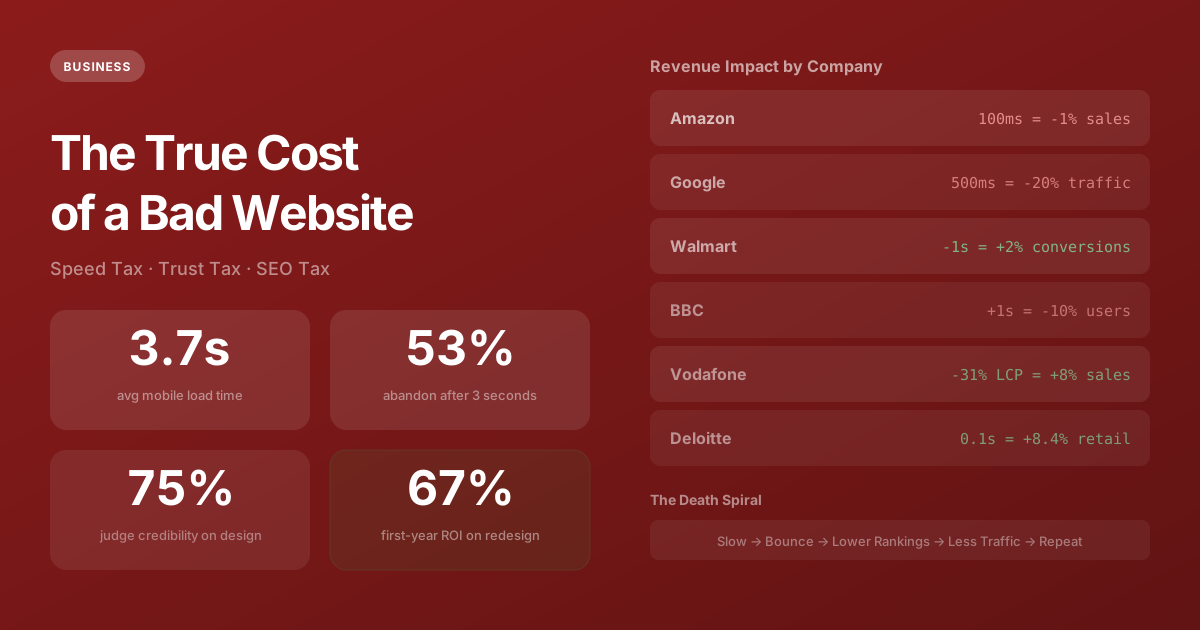
Google's research is unambiguous: 53% of mobile users abandon a site that takes longer than 3 seconds to load. Think about that — more than half your mobile visitors leave before they see your first headline, your best offer, or your product. They don't bounce because your content is bad. They bounce because your site is slow.
The relationship between page speed and revenue has been studied by the world's largest companies, and the results are consistent across industries:
- Amazon calculated that every 100ms of added latency cost them 1% in sales. At Amazon's scale, that's approximately $1.6 billion per year per second of delay.
- Walmart found that for every 1-second improvement in page load time, conversions increased by 2%. Their mobile conversion rate improved by 98% after a comprehensive performance overhaul.
- Google reported that a half-second increase in search results load time reduced traffic by 20%.
- BBC discovered they lost an additional 10% of users for every extra second of page load time.
- Vodafone improved LCP by 31% and saw an 8% increase in sales, a 15% improvement in lead-to-visit rate, and an 11% increase in cart-to-visit rate.
These aren't outliers — they're the norm. A Deloitte study of retail and travel sites found that a 0.1-second improvement in mobile site speed resulted in an 8.4% increase in conversions for retail and a 10.1% increase for travel. The math is simple: if your site loads in 4 seconds instead of 2, you're leaving 15-30% of your potential revenue on the table. Every day.
The Trust Tax: Revenue Lost to Outdated Design
Speed isn't the only factor. Visual credibility matters enormously — especially for businesses where trust is a prerequisite for conversion (which is most businesses).
A landmark Stanford study on web credibility found that 75% of users judge a company's credibility based on its website design. Not its products. Not its reviews. Its website design. If your site looks like it was built in 2018 — with stock photography, generic templates, tiny text, and cluttered layouts — visitors assume your business operates with the same attention to detail.
This effect is amplified in B2B contexts. When a potential client is evaluating agencies, consultancies, or technology partners, your website is the first filter. A Hinge Research Institute study found that 80% of B2B buyers will eliminate a potential vendor based on their website alone, before ever talking to a salesperson. You never know about the deals you lost because someone visited your site, judged it, and moved on to a competitor with a more professional web presence.
The Mobile Trust Gap
Over 60% of web traffic is now mobile, and mobile users are even more sensitive to bad design. Tiny tap targets, horizontal scrolling, text that requires pinching to read, and pop-ups that can't be dismissed on small screens — these aren't just annoyances, they're conversion killers. Google reports that 61% of users are unlikely to return to a mobile site they had trouble accessing, and 40% will visit a competitor's site instead.
The SEO Tax: Traffic Lost to Technical Neglect
Since Google's Core Web Vitals update became a ranking factor, page experience signals directly affect search rankings. This isn't speculation — it's documented. Sites that fail LCP (Largest Contentful Paint), INP (Interaction to Next Paint), or CLS (Cumulative Layout Shift) thresholds are penalized in search results relative to sites that pass.
We've seen this firsthand. Clients have gained 30-50 positions in search results simply by fixing Core Web Vitals, with no content changes at all. The content was already good — Google just couldn't see it because the technical foundation was broken.
The Compound Effect of Bounce Rates
A slow site creates a death spiral. Here's how it works:
- Slow load time → high bounce rate. A 1-second delay increases bounce rate by 32%. A 3-second delay increases it by 90%.
- High bounce rate → Google interprets this as poor content quality. If users consistently leave your site within seconds, Google assumes your page doesn't satisfy the search intent.
- Lower quality signal → lower search rankings. Your pages drop in results, meaning fewer people find you.
- Less traffic → less revenue → less budget for improvements. The cycle reinforces itself.
Breaking this cycle requires investing in the technical foundation — not just adding more content on top of a broken infrastructure.
What a Quality Website Actually Costs
The most common objection to a website rebuild is cost. So let's be transparent about what things actually cost — and compare those numbers to the cost of doing nothing.
Website Types and Typical Investment
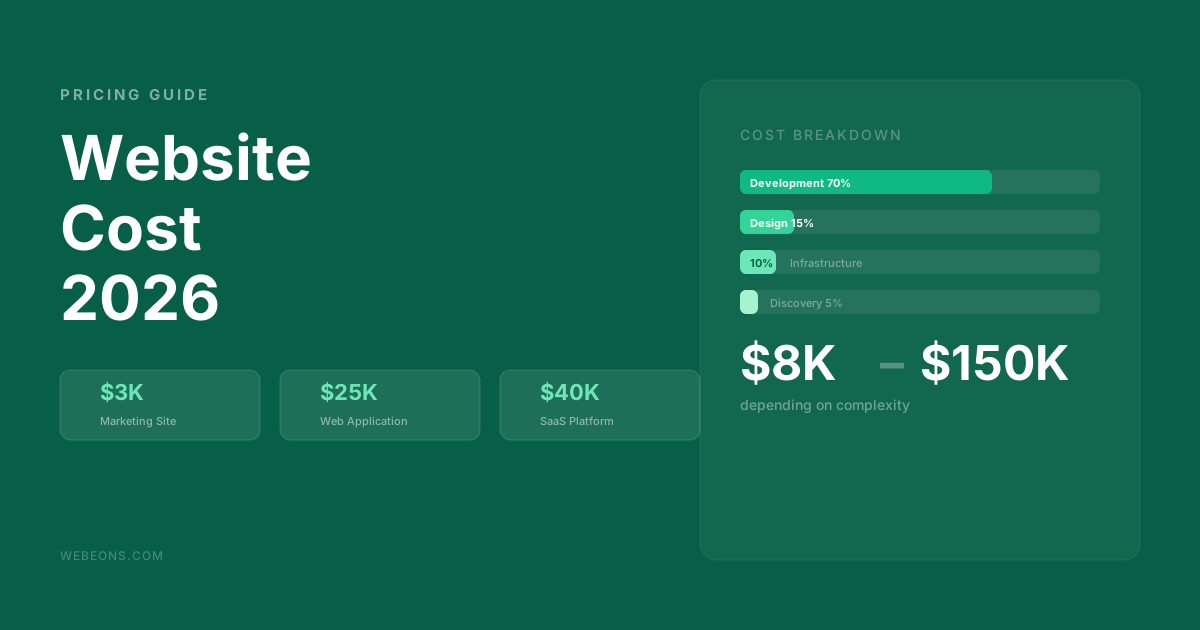
- Marketing/brochure site (5-15 pages) — $8,000 to $25,000. Includes custom design, responsive development, SEO optimization, CMS integration, and performance tuning.
- E-commerce site — $15,000 to $60,000. Adds product management, payment processing, inventory integration, and conversion optimization.
- Custom web application — $25,000 to $100,000+. Includes user authentication, database design, API development, and application-specific features.
- SaaS product — $40,000 to $150,000+. Adds multi-tenancy, subscription billing, admin dashboards, and infrastructure for scale.
The ROI Calculation
A $15,000 website redesign that improves conversion rate by just 2% on a site with $500,000 in annual revenue generates $10,000 in additional revenue per year. That's a 67% return on investment in year one alone — and the improvement compounds as traffic grows. Over three years, that $15,000 investment generates $30,000-$50,000 in additional revenue, assuming modest traffic growth.
Compare that to the alternative: spending $0 on a rebuild while losing $10,000+ per year in missed conversions. Over the same three years, the "savings" of not investing cost you $30,000-$50,000 in lost revenue. Inaction isn't free — it's the most expensive option.
Five Signs Your Website Needs a Rebuild
Not every website needs a ground-up rebuild. Sometimes targeted improvements — performance optimization, mobile fixes, content updates — are sufficient. But if you recognize three or more of these signals, patching isn't going to cut it:
- Page load time exceeds 3 seconds on mobile. Test at pagespeed.web.dev. If your Performance score is below 60, you're actively being penalized by Google.
- The design hasn't been refreshed in 3+ years. Design trends move fast. A site from 2022 looks dated in 2026. Users notice, even if they can't articulate why.
- Mobile experience is an afterthought. If your mobile site is just a squeezed desktop layout with tiny buttons and horizontal scrolling, you're failing 60%+ of your visitors.
- Updating content requires a developer. If your marketing team can't update text, add blog posts, or change images without filing a developer ticket, your content will always be stale.
- You can't track what's working. No analytics, no conversion tracking, no heatmaps. You're flying blind, making decisions based on gut feeling instead of data.
What Getting It Right Looks Like
The companies we've rebuilt websites for see consistent, measurable results:
- Page load times drop by 60-80% — from 3-5 seconds to under 1.5 seconds
- Bounce rates decrease by 25-40% — visitors stay and engage instead of leaving immediately
- Conversion rates improve by 15-35% — more visitors take the desired action
- Organic traffic increases 30-100% within 6 months as Core Web Vitals improve and Google rewards the better experience
- Maintenance costs decrease as modern frameworks eliminate plugin dependencies and security vulnerabilities
On average, the investment pays for itself within the first year through increased conversions alone — not counting the long-term SEO benefits, reduced maintenance costs, and improved brand perception.
The Bottom Line
A great website isn't an expense — it's the highest-ROI marketing investment most businesses can make. The question isn't whether you can afford to rebuild your website. Talk to us about a redesign — we respond within 24 hours. The question is whether you can afford not to — while your competitors invest in faster, better-designed, higher-converting web experiences that capture the customers you're losing.
Every day your underperforming website stays live is a day you're paying the speed tax, the trust tax, and the SEO tax. The cost of inaction isn't zero. It's the most expensive option on the table.
Need help with this?
We build exactly what this article describes — production-grade digital products for ambitious companies.
Start a Project →